Wedding Lighting That Sets the Mood, Without the Stress
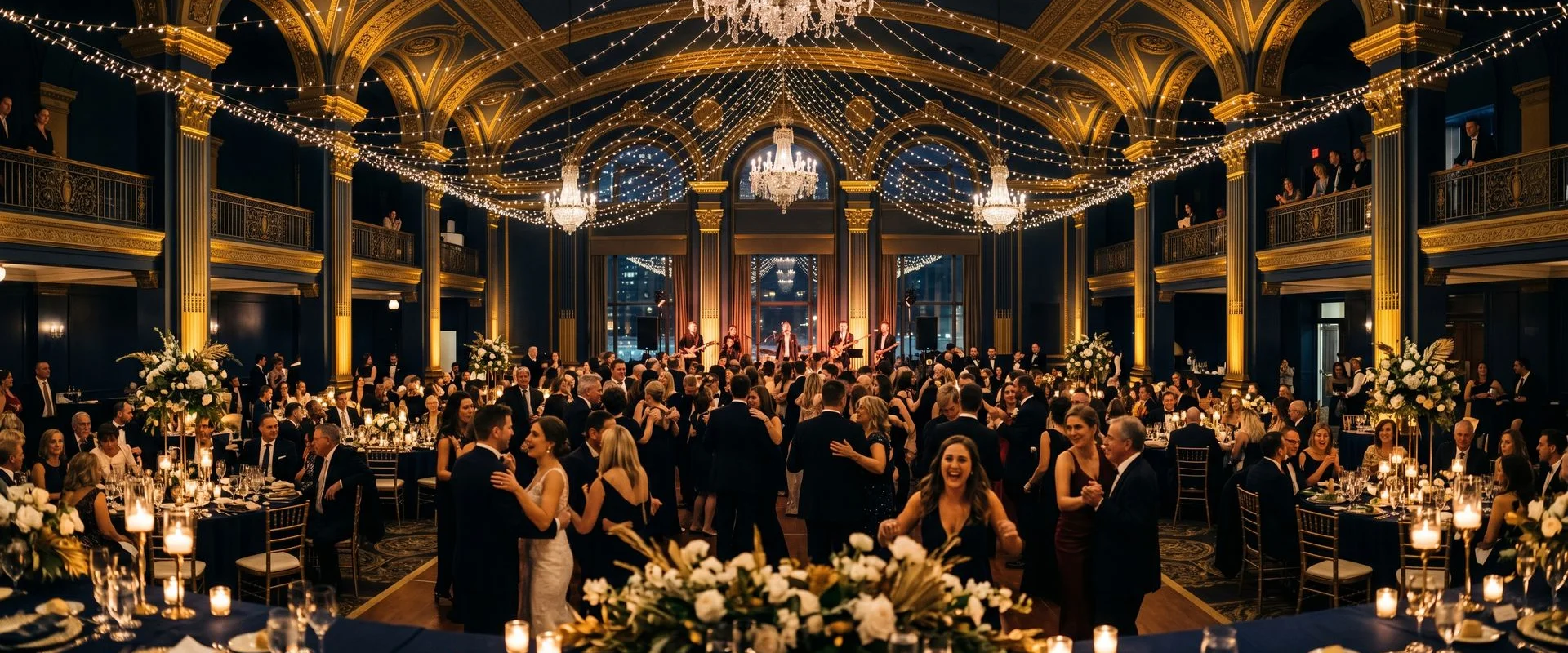
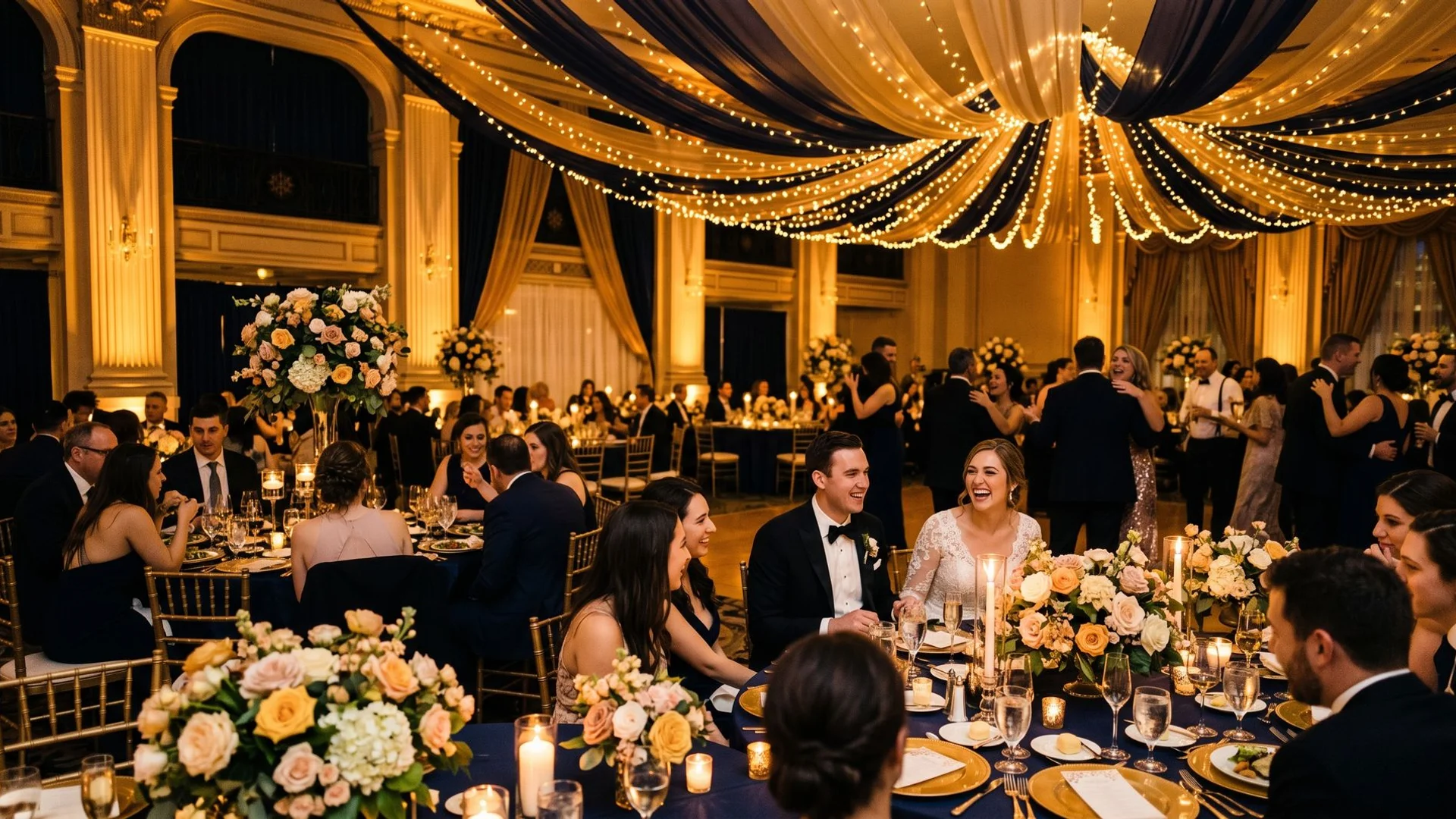
From a 30-guest backyard ceremony to a 600-guest multi-day celebration, the lighting is what your guests will remember in photos and what you’ll feel in the room. We design wedding lighting in Toronto and across the GTA that’s built around your venue, your colours, and the moment, not a fixed package.
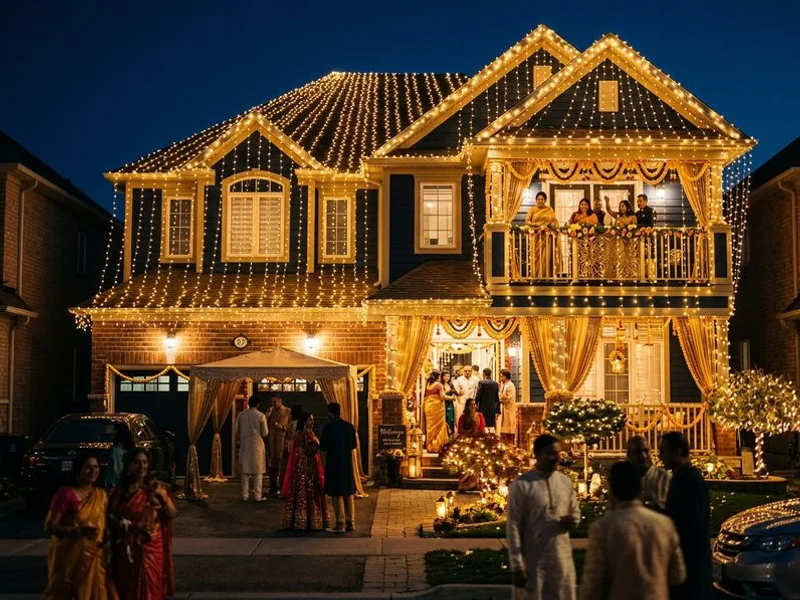
Our certified team of event lighting designers in Toronto has illuminated over 1,000 events since 2019. We know how the Fairmont Royal York’s ceiling height changes uplight throw, why Casa Loma needs freestanding structures, and how to keep a fairy-light drape safe across the facade of a South Asian wedding house in Brampton.
What Your Wedding Lighting Includes
Every wedding package is custom, but most include some combination of:
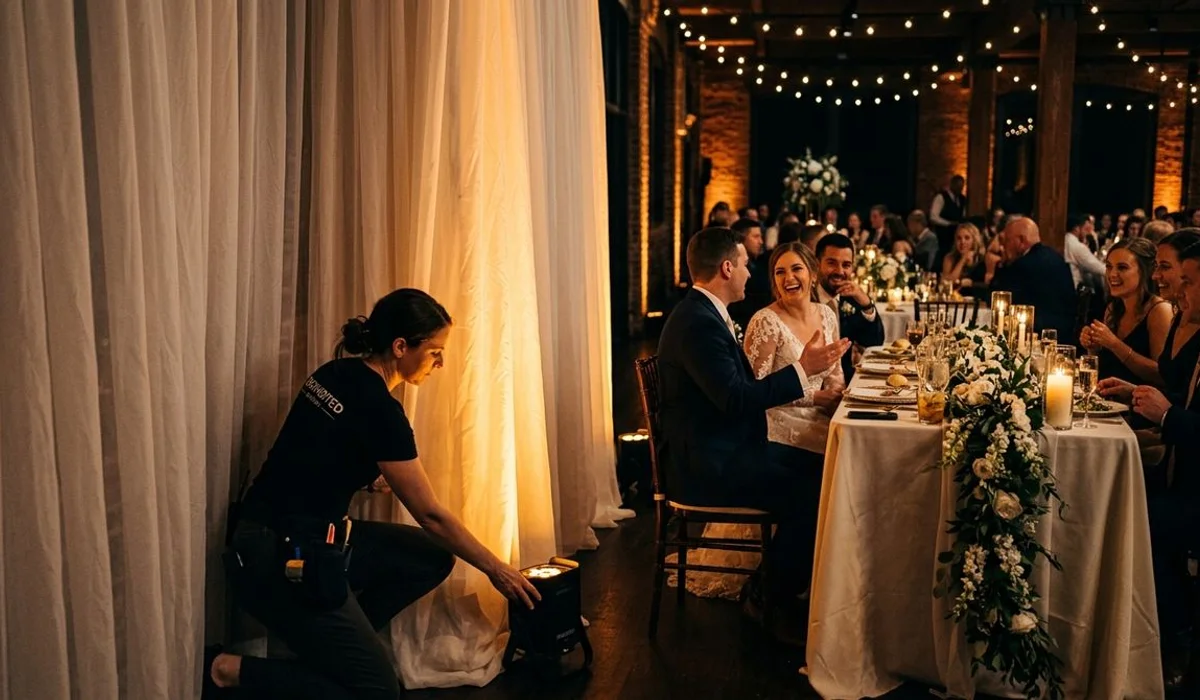
- Wireless battery-powered uplighting dialed to your colour palette, with no extension cords across the dance floor.
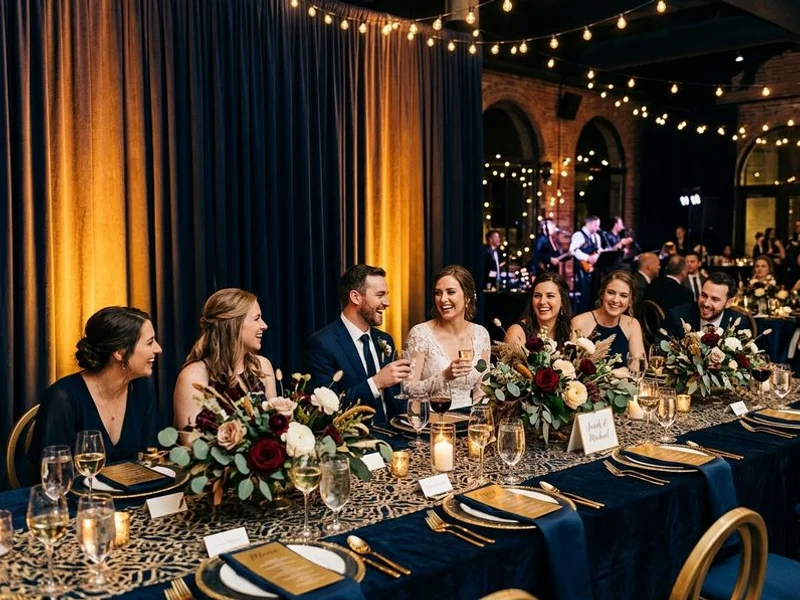
- Pin-spotting on florals, cake, and head table so the photographer captures the centrepieces you spent months choosing.
- Fairy-light drapery across head-table backdrops, ceiling sweeps, or (for South Asian wedding houses) the full facade.
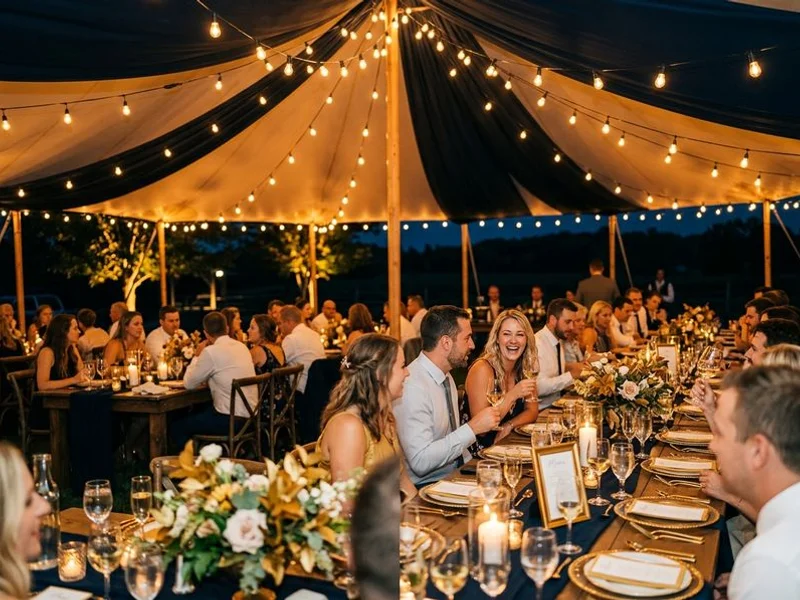
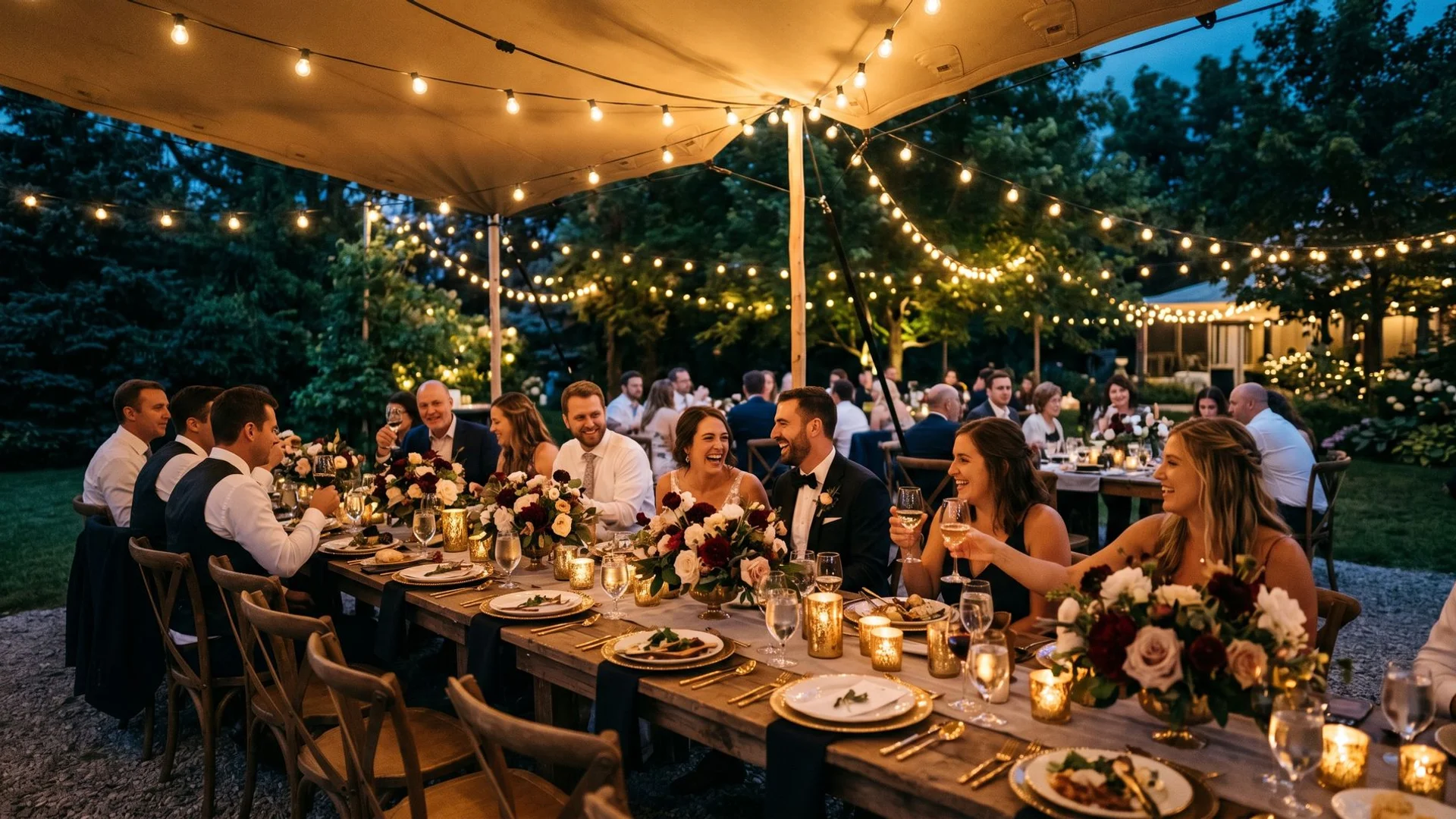
- Tent and canopy washes for outdoor ceremonies, with weatherproof, GFCI-protected power.
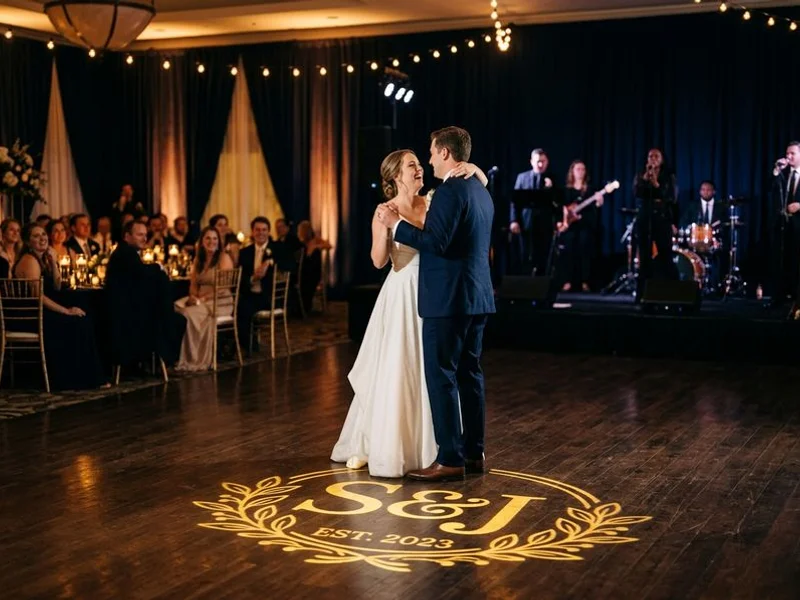
- Monogram and pattern gobo projection for the dance floor or ballroom walls.
- A dedicated on-site technician who stays through the reception for live dimming cues and troubleshooting.
South Asian Wedding House and Cultural Lighting
South Asian and Diwali-adjacent weddings are a core specialty. Fairy-light draping across the entire facade of a wedding house, across balconies, rooflines, and balustrades, needs the right fixtures, weatherproof power, and an installer who’s done it before. We have.
Our team is comfortable with multi-day setups: a sangeet on Friday, a sangeet hall on Saturday, a reception on Sunday. We coordinate the timing so each day’s look is distinct.
The Booking Process
- Tell us about your event. Date, venue, guest count, vision, colours, any cultural elements.
- We respond within one business day with a discovery call to dig into the details.
- Site visit and design. We walk your venue, draft a lighting plan, and share it back with you to refine.
- Install and on-site support. Our crew installs to ESA standards and stays for the event.
Book at least 4 to 6 weeks ahead for peak wedding season. Saturdays in May, June, September, and October fill first.
How to Plan Wedding Reception Lighting in Toronto
Planning reception lighting starts with zones, not fixtures. A well-lit wedding has at least four distinct zones - the entrance, the ceremony or cocktail space, the head table and backdrop, and the dance floor - each requiring a different lighting approach and different equipment. Getting these zones right is more important than the total fixture count.
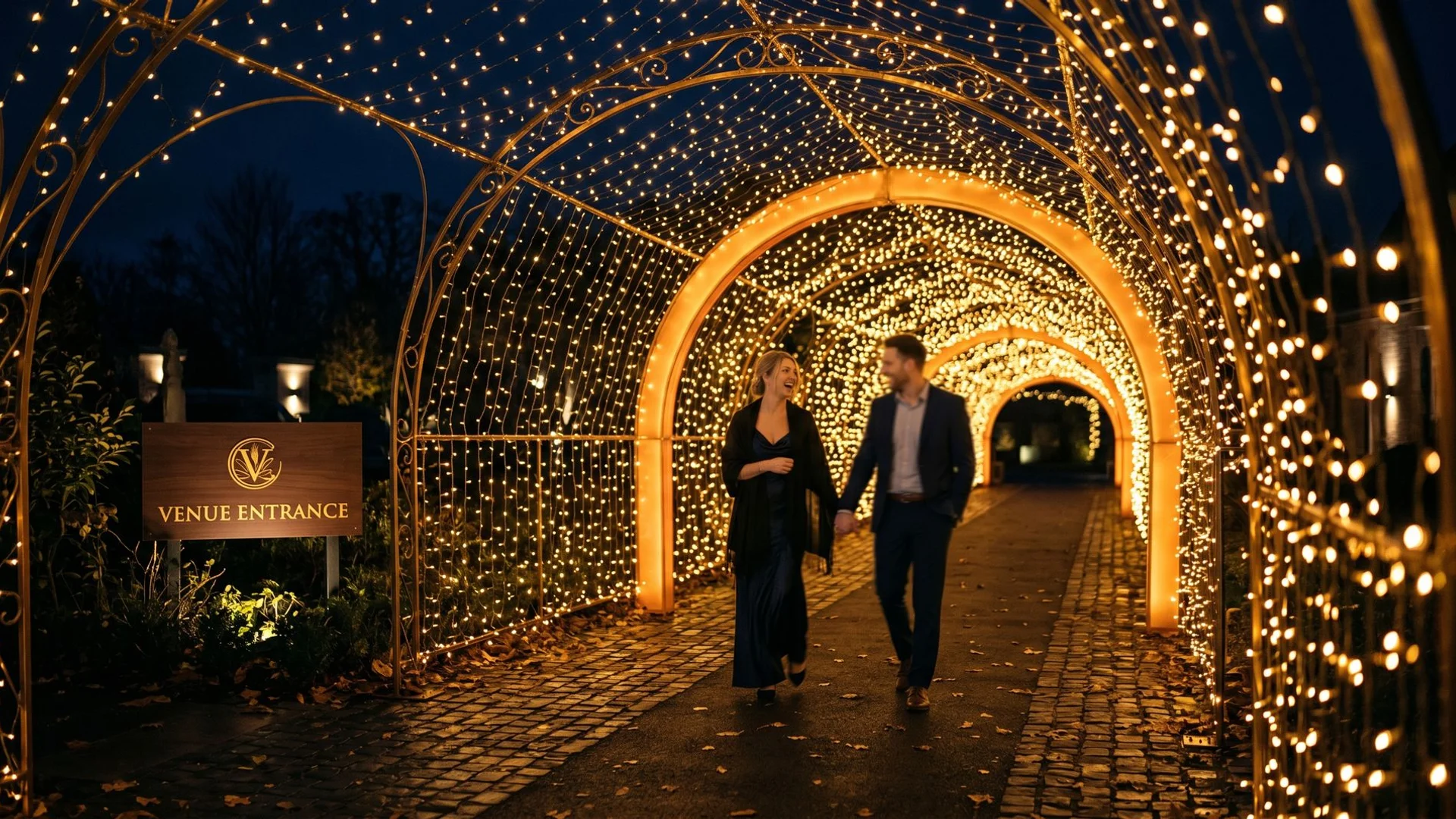
The entrance sets the emotional tone for every guest. A tunnel of warm fairy lights or a pair of flanking uplights in your colour palette tells arriving guests what kind of evening this is before they’ve said a word to anyone. For outdoor venues in Mississauga and Brampton, this often means a pathway of ground-staked uplights in 2700K warm white or amber - a colour temperature chosen specifically because it photographs well without the orange tinge that 2200K tungsten creates in digital images.
The head table and backdrop typically get the highest lighting intensity per square metre at a Toronto wedding reception. Pin-spotting on floral centrepieces, table garlands, and the cake requires a Source Four narrow-beam fixture at a minimum 10:1 throw ratio - meaning a fixture mounted 15 feet up should throw a 1.5-foot circle on the table surface. This precision is what separates a professional pin-spot grid from a floodlight wash. Wireless battery-powered uplights behind the backdrop are dialled to match the centrepiece colour; the photographer will thank you for keeping all colour references consistent.
The dance floor is where event lighting designers in Toronto use colour most aggressively. Warm amber for early-evening first dance transitions to brighter, more dynamic washes as the evening progresses. For South Asian weddings, this often means a full RGBW (red-green-blue-white) wash capability so the DJ and lighting team can respond to different music sets - Bollywood, Bhangra, and Western pop each have different lighting expectations from the guests on the floor.
Working with Your Venue’s Constraints
GTA wedding venues impose their own rules on lighting. Casa Loma prohibits ceiling rigging; Liberty Grand has strict truss placement zones; the Fairmont Royal York requires fixtures to be mounted on approved structures only. Before you book any lighting package, your designer should walk the venue and understand the electrical capacity, load limits, and any rigging restrictions. Sites in Vaughan like Chateau Le Jardin or Paramount EventSpace have their own house lighting systems that need to be managed in coordination with your external lighting team to avoid conflicts.
House Lighting for Weddings in Toronto: South Asian Facades, Fairy Lights, and Electrical Safety
A South Asian wedding house setup is one of the most technically demanding residential lighting jobs in the GTA. It’s not just wrapping some fairy lights around a door - it’s dressing an entire residential facade, including rooflines, balustrades, second-floor balconies, and sometimes a tent structure in the backyard, with temporary outdoor electrical that needs to run safely for two or three consecutive nights.
The key technical requirement is weatherproof power distribution. Every string of lights on an outdoor facade should terminate at an IP65-rated junction box, and every circuit should run through a GFCI (ground fault circuit interrupter) breaker. Brampton and Mississauga homes commonly have 200-amp service panels, but a full facade wrap plus tent lighting can draw 30-50 amps depending on fixture count - the power design needs to be mapped before a single nail goes in. Overloading a residential panel on Diwali weekend is how outdoor setups become hazards; ESA-compliant design prevents this.
For fairy-light draping specifically, the fixture matters. Consumer fairy lights from big-box stores are rated for a single season and use thin 22-gauge wire. Commercial-grade fairy lights for outdoor facades use 16 or 18-gauge wire, IP44-rated minimum for light rain, and lamp sockets rated for 50,000-hour bulb life. The difference is visible in the density of light points, the evenness of the glow, and the longevity over a three-night install. Facades in Castlemore and Bramalea that have been done with commercial fixtures for the sangeet night look as crisp on the wedding day as they did on day one.
Tent integration adds a second layer of complexity. A 40-by-60-foot mandap tent on a backyard in Brampton needs its own dedicated power run from the panel - ideally a 30-amp or 50-amp sub-feed run in a surface-mounted conduit along the property perimeter. The tent lighting itself (canopy wash, chandelier suspension, perimeter uplights) should be treated as a separate load from the facade lights, with its own GFCI protection and its own run to the panel. This prevents a tripped breaker on the facade from killing the tent lights during the ceremony.
Indoor vs. Outdoor Wedding Lighting: What Changes in Ontario
The fundamentals of lighting design - colour temperature, fixture spacing, intensity levels - stay the same indoors and outdoors. What changes dramatically is power, weatherproofing, and the Ontario climate.
Power Access and Distribution
Indoor venues have permanent, professional-grade power infrastructure. A ballroom at a North York banquet hall will have multiple 20-amp or 30-amp circuits already distributed around the room, dedicated for lighting and AV equipment. Outdoor venues - a farm in Caledon, a backyard in Etobicoke, a vineyard within driving range - may have a single 15-amp outdoor outlet and nothing else. Every outdoor setup needs its own power distribution plan: generator sizing, extension cable gauge (12-gauge minimum for outdoor runs), GFCI protection at every outlet, and a cable layout that keeps cords off walking paths.
Weatherproofing Requirements
Outdoor fixtures need to be rated for the environment. The IP (Ingress Protection) rating system classifies how well a fixture handles dust and moisture. IP65 means the fixture is completely dust-tight and can handle low-pressure water jets from any direction - the minimum acceptable rating for an outdoor Ontario setup. IP44 (splash-proof) is suitable for covered tent applications where direct rain exposure is unlikely. Consumer-grade string lights sold for outdoor use in Canada are often rated IP44 or lower; they’re adequate for a single dry summer evening but not for a setup running across multiple nights or in variable weather.
Seasonal Considerations
Ontario wedding season runs May through October. May and September evenings can drop to 5-10 degrees Celsius, which affects the colour output of some LED fixtures and the flexibility of cable jackets. June through August is the opposite problem - ambient heat and direct sun exposure can cause battery-powered uplights to overheat if placed on paving stones without air gap. October outdoor weddings in Etobicoke or Oakville often add fog or mist risk that increases moisture exposure for any fixture not rated above IP65.
Wedding Lighting Design Options Explained
Understanding the terminology helps couples communicate what they actually want. The wedding lighting industry uses terms - uplighting, pin-spotting, gobo, wash - that are specific to the trade and not always obvious to someone planning their first major event.
Wireless Battery-Powered Uplighting
Uplights are compact LED fixtures placed on the floor around the perimeter of a room, aimed upward to wash walls and columns in colour. The “wireless battery-powered” variant has no power cable - each fixture runs on a rechargeable lithium-ion battery pack, typically lasting 8-12 hours per charge on a warm-white setting. This eliminates cable runs across floors, which improves both safety and aesthetics. A 30-guest backyard reception typically uses 16-20 uplights; a 300-guest ballroom in Vaughan might use 48-64. Colour is set via a DMX wireless controller and can be changed during the event for ceremony-to-reception transitions.
Pin-Spotting
Pin-spotting is narrow-beam projection onto a specific object - a centrepiece, a wedding cake, a floral arch. It requires a fixture with a very narrow beam angle (typically 10-15 degrees) mounted overhead or on a column, aimed precisely at the target. The effect is a pool of warm light that isolates the object from the ambient wash and creates a dramatic focal point in photos. Pin-spotting on a head table backdrop with 12 floral pieces requires 12 individual fixtures, each aimed and locked off before the event. This is technically precise work; a two-degree error in aim at a 15-foot throw translates to a 6-inch miss on the table surface.
String Lights and Fairy Lights
String lights and fairy lights are distinct products. String lights use larger bulbs (typically G40 or ST64 Edison-style LED) spaced on a thicker cable, used for festoon overhead layouts and patio canopies. Fairy lights use micro LEDs on a thin wire, used for draping, wrapping, and cascading across fabric and branches. Both come in warm white (2700K), neutral white (3000K), and cold white (4000K) - for weddings, 2700-3000K is almost always the right choice for photographs and ambiance.
Monogram and Pattern Gobo Projection
A gobo is a shaped metal or glass template placed inside a spotlight to project a pattern onto a surface. For weddings, custom steel gobos laser-cut with initials, wedding dates, or logos are the most common application. A glass gobo can carry a full-colour photographic image; steel gobos are single-colour but more durable. Standard GTA applications include projecting initials on a dance floor, a floral pattern on a ballroom wall, or a logo on a stage at a Markham Convention Centre event. The projector needs to be positioned at the right throw distance (typically 10-30 feet) and the surface needs to be relatively smooth and uniform - textured brick scatters the image.
How Far in Advance to Book Wedding Lighting in the GTA
The short answer: book at least 4-6 weeks ahead. The real answer depends on your wedding date.
Peak wedding season in the GTA runs from late May through the end of June and picks back up from mid-September through mid-October. Saturday bookings during those windows fill fastest. For a Saturday in September - the busiest single month for GTA weddings - booking 6 weeks ahead is cutting it close; booking 10-12 weeks ahead is more realistic if you want a specific setup.
The reason for the lead time is not just crew availability. A proper wedding lighting design involves a site visit to the venue, a colour-matching session to dial in the uplights, and often coordination with the venue AV team to ensure the lighting plan works within their power grid. A site visit books out ahead of the event, the design needs revision and sign-off time, and any custom fabrication (gobo cutters, specialty fixtures, bespoke chandelier rigging) needs procurement lead time.
South Asian multi-night weddings in Brampton and Mississauga require even more lead time because the setup spans multiple calendar days (often Thursday install, Friday sangeet, Saturday baraat and reception, Sunday teardown) which monopolises a crew for four days. Those bookings fill particularly early - mid-summer bookings for a fall Diwali or November wedding are not unusual.
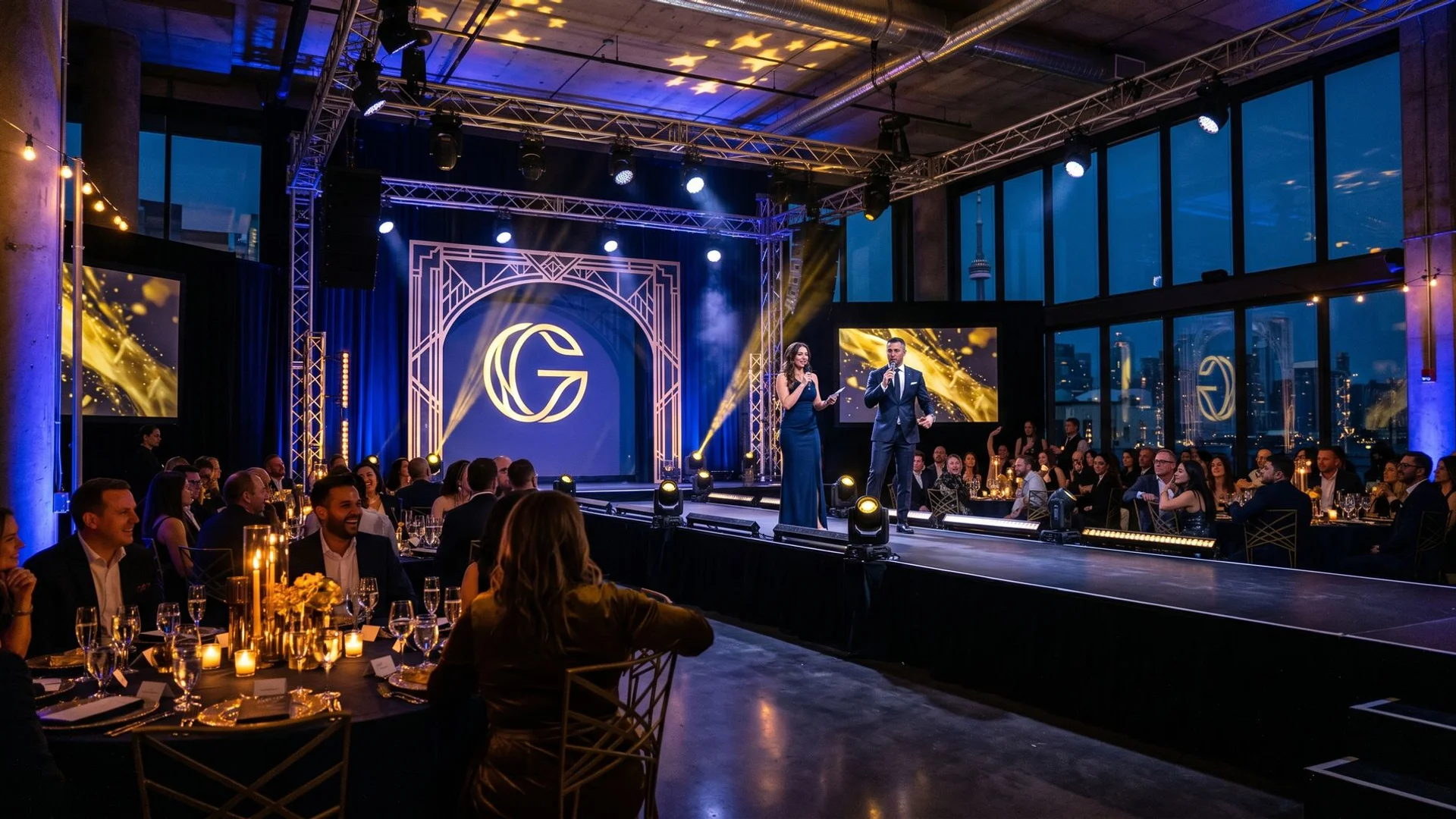
For commercial events - corporate galas at a Vaughan banquet hall, office holiday parties, product launches at the Markham Convention Centre - booking 4-6 weeks ahead is the baseline for standard setups. DMX-programmed custom shows with pre-visualization run require 8-12 weeks for full design, programming, and rehearsal.
Professional Wedding Lighting vs. DIY String Lights: What You’re Actually Paying For
DIY wedding lighting is the first thing many couples explore and one of the first things they abandon once they understand what’s involved. It’s worth explaining what specifically separates a professionally installed setup from a DIY string light job, because “it looks more professional” is not an answer.
The first difference is equipment quality. Consumer string lights from a hardware store use 22-gauge wire, cheap lamp sockets, and plastic connectors rated for 1-2 seasons of outdoor use. Professional outdoor string lights use 16-18-gauge wire, commercial E26 sockets rated for 50,000+ hours, and IP44 or IP65 waterproof connectors. The light output is brighter per bulb, more even across the string, and consistent in colour temperature from bulb to bulb. Consumer strings have visible variation between bulbs; commercial-grade strings do not.
The second difference is safety and code compliance. A DIY outdoor setup rarely includes GFCI protection at every outlet, rarely uses outdoor-rated wire gauge appropriate for the circuit load, and rarely has anyone on-site qualified to troubleshoot an electrical fault mid-event. The Ontario Electrical Safety Code (ESA) requires GFCI protection on all outdoor circuits with outlets in damp or wet locations. An unprotected circuit running a 600-watt string light load across a wet backyard in Etobicoke is an ESA violation and a fire risk.
The third difference is on-site operation. A professional lighting team stays through the reception for live dimming cues, colour transitions, and troubleshooting. DIY lights are set and left. If a breaker trips, if a bulb section goes dark during the first dance, if the weather turns and a connection comes loose, there’s no one to fix it. For a $30,000 wedding, spending $1,500-$4,000 on professional lighting with on-site support is risk management, not a luxury add-on.
What Affects Wedding Lighting Cost in the GTA
Wedding lighting in the GTA is custom-quoted because no two events are the same. A 50-guest backyard ceremony and a 400-guest South Asian multi-night celebration have genuinely different fixture counts, labour requirements, and power complexity. That said, the factors that drive pricing are consistent.
Fixture count is the primary driver. Wireless battery uplights, pin-spot fixtures, string lights, gobo projectors, and chandeliers all have a per-unit cost for rental and setup. A 16-uplight backyard setup is categorically different from a 64-uplight ballroom setup. The relationship is roughly linear - more fixtures means proportionally more cost.
Installation complexity is the second driver. A flat-floored ballroom in North York with existing power infrastructure costs less to install than a heritage venue in Toronto’s Annex with uneven surfaces, limited power access, and a prohibition on anchoring to any surface. South Asian wedding houses add complexity through multi-day setup, exterior work, high-reach facade access, and the need to coordinate power with the homeowner.
Design customisation adds cost for custom gobos (typically $150-$300 for laser-cut steel, $400-$800 for colour glass), bespoke chandelier rigging, and any DMX programming beyond basic colour wash. Pixel-mapped ceiling sequences or music-synced light shows are in a different pricing tier from static ambient washes.
Crew time is the third major factor. A two-person crew for a 4-hour install and 6-hour event is the baseline. Multi-night South Asian wedding setups involve 3-4 crew across 4 days; custom tunnel installs may require 5-6 crew for structural build-out.
Marquee Letters and Monogram Gobo Projection for Weddings
Marquee letters and custom gobo projection have become the two most-requested visual upgrades in GTA wedding lighting over the past five years, for different reasons - marquee letters are purely decorative and photogenic; gobo projection is both an aesthetic choice and a technical one.
Marquee letters are freestanding illuminated structures - typically 4-6 feet tall - spelling out LOVE, BRIDE, MR & MRS, or the couple’s initials. They use warm Edison bulbs internally and cast soft ambient light outward, making them both a visual centrepiece and a functional light source in low-ambiance settings. They’re placed at photo backdrops, at venue entrances, and occasionally on the head table. For South Asian weddings, Urdu or Punjabi script transliterations are available through custom fabrication on 8-12 week lead times.
Custom monogram gobo projection is a more technically demanding upgrade. A custom steel gobo is laser-cut with the couple’s initials, the wedding date, or a custom design. The gobo is mounted inside an ellipsoidal spotlight, which projects the image onto the dance floor, a wall, or a ceiling drop. Steel gobos project in a single colour (the colour of the spotlight lamp); glass gobos can carry full-colour images. For most weddings, a warm gold or silver steel gobo on the dance floor in the couple’s chosen colour is the right specification - it reads clearly in photos, holds up for the full night of dancing, and doesn’t compete with the DJ’s effects.
The key technical decision for gobo projection is throw distance and surface type. A 15-foot throw at a standard ballroom ceiling height gives a clean 3-4 foot diameter projection on a smooth hardwood dance floor. Rough stone floors scatter the image; carpeted floors are not suitable for dance floor gobo unless the carpet is pulled. Outdoor gobo projection on paving stone or concrete works well and is increasingly popular at Brampton and Mississauga backyard wedding houses where the evening’s focal point is the outdoor patio rather than a ballroom.
Related Questions Toronto Couples Ask About Wedding Lighting
How many uplights do I need for my wedding reception?
The standard planning ratio is one wireless uplight per 8-10 linear feet of wall perimeter, or approximately one per 80-100 sq ft of total floor area for full ambient coverage. A 5,000 sq ft ballroom in Vaughan might use 50-64 uplights; a 1,200 sq ft private dining room at a Liberty Village restaurant might use 12-16. The ratio increases in rooms with columns, alcoves, or architectural details that benefit from accent lighting beyond perimeter wash.
Can wedding lighting be adjusted during the event?
Yes. Wireless DMX-controlled battery uplights can be re-coloured and re-dimmed from a handheld controller at any time during the event. This enables transitions from ceremony white to cocktail hour amber to reception deep-colour without anyone moving a fixture. A dedicated on-site technician manages these transitions; at large events, cues are pre-programmed into the DMX controller and triggered manually at the right moments.
What’s the difference between a steel and glass gobo for monogram projection?
Steel gobos are laser-cut from stainless steel and project a single-colour image - the monogram appears in whatever colour lamp is in the spotlight. They’re more durable, cheaper (typically $150-$250 for custom cuts), and hold up better under the heat of an ellipsoidal lamp. Glass gobos can carry full-colour or gradient imagery but are fragile under heat cycling and more expensive. For wedding monograms in Toronto, steel is almost always the right choice unless a full-colour photographic image is specifically required.
Do you serve venues outside downtown Toronto?
Yes. We regularly work at venues across the GTA - Chateau Le Jardin and Paramount EventSpace in Vaughan, Markham Convention Centre and various banquet halls in the York Region, Liberty Grand and Casa Loma in Toronto proper, and banquet halls throughout Brampton, Mississauga, Scarborough, and Etobicoke. If the venue is within 90 minutes of downtown Toronto, we can typically serve it.
What happens if it rains during an outdoor wedding reception?
Every outdoor setup we install uses IP65-rated connectors and outdoor-rated fixtures minimum. Power distribution runs through GFCI-protected circuits that trip automatically if moisture compromises a circuit - protecting equipment and guests. We provide a written rain contingency plan before every outdoor event and keep our on-site technician with rain-response protocols. If an extreme weather event requires a design change mid-event, the technician handles the adjustment on the spot.